Keretsi handbook featured

Handbook on Restoring Traditional Lime Mortars

This handbook documents a methodology for renovating interior plastering systems on stone masonry using low-impact lime- and clay-based materials enhanced with vegetable fibers. In this regard, it illustrates how a plastering system with enhanced thermal properties can be employed to modestly enhance the energy efficiency of a historic structure without compromising its architectural features. These interventions rely on local, natural materials and techniques based on traditional knowledge and the principles of reuse and recycling.

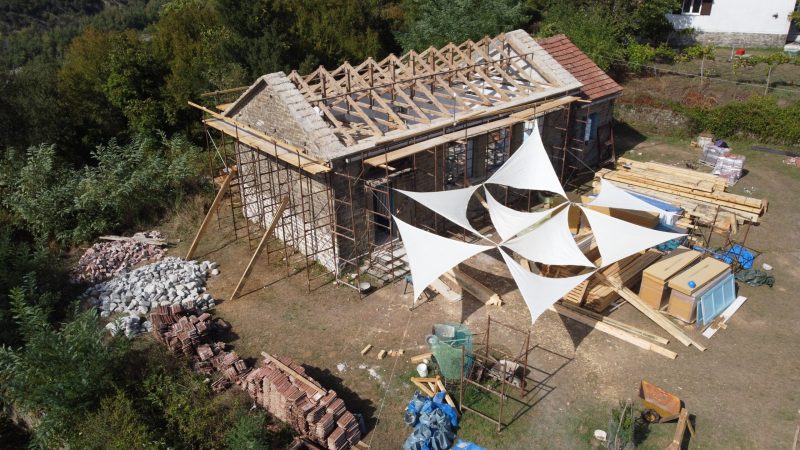
The research and implementation of the works was part of the project  KERETSI.

The creation of the handbook was supported by the INTBAU Grassroots Grants Programme.
Date: 13 March 2026

Rel. project: KERETSI TZOUMERKA SCHOOL

See also...

“HERO – Heritage Ecological Renovation for Inclusion Opportunities –  is  an Erasmus+ cooperation project associating 5 partners organization involved in the field of heritage restoration, eco-construction,  training and social inclusion. Between 2021 and 2024, partners have gathered their expertise to develop, test and improve new approaches to heritage restoration : 

  • Inclusive and adapted to people far from training and employment
  • Eco-friendly and respectful of the environment

The H.E.R.O project was implemented under the Erasmus+ programme and was completed after 3 years (2021-2024) of transnational cooperation between 4 actors Acta Vista (France) leading partner, Bao Formation (France), Pour la Solidarite (Belgium), 4Grada Dragodid (Croatia), Boulouki (Greece).

This article presents preliminary findings from an extensive research project titled ‘Burning the Bones of the Earth’, which began in 2021. It documents the technology of traditional lime kilns in the trans-border region between Albania and Greece.

Authors: Ioanna Ntoutsi, Faidon Moudopoulos-Athanasiou.

The file is available in English.

‘Burning the Bones of the Earth’ was initiated in November 2021 and concluded two years later, following extensive field research in several locations of Epirus in NW Greece and in regions of S. Albania. Its objective was to trace and document the traditional craftsmanship of wood-fired, flare-type lime kilns on both sides of the border; to explore the knowledge, practice, and social dimensions regarding the lime kiln technology and the ways it evolved in the two neighbouring countries. Full documentation of the project was uploaded at the British Museum’s Digital Resources Website on November 2025 and is now fully accessible to the community. In this resource you can find the documentation guide (downloadable file) and the full programmes website:

Burning the Bones of the Earth — Documenting the Traditional Lime Kilns Technology Across the Albanian-Greek Border

The file is available in English.

Privacy Overview

This website uses cookies so that we can provide you with the best user experience possible. Cookie information is stored in your browser and performs functions such as recognising you when you return to our website and helping our team to understand which sections of the website you find most interesting and useful.