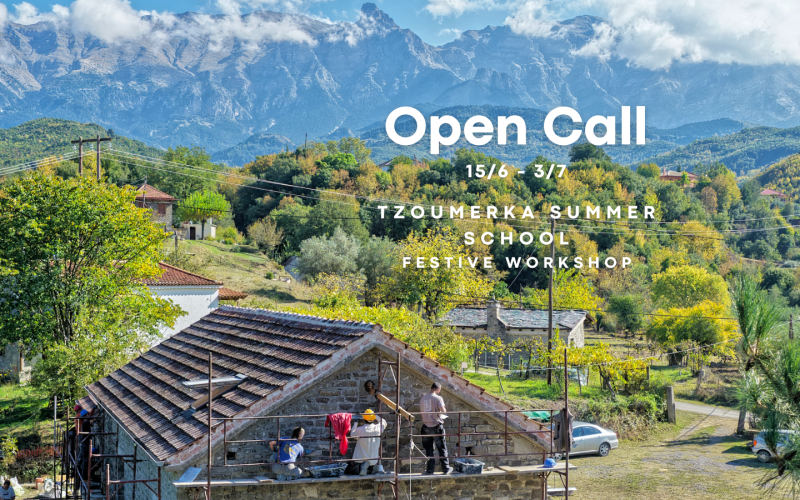
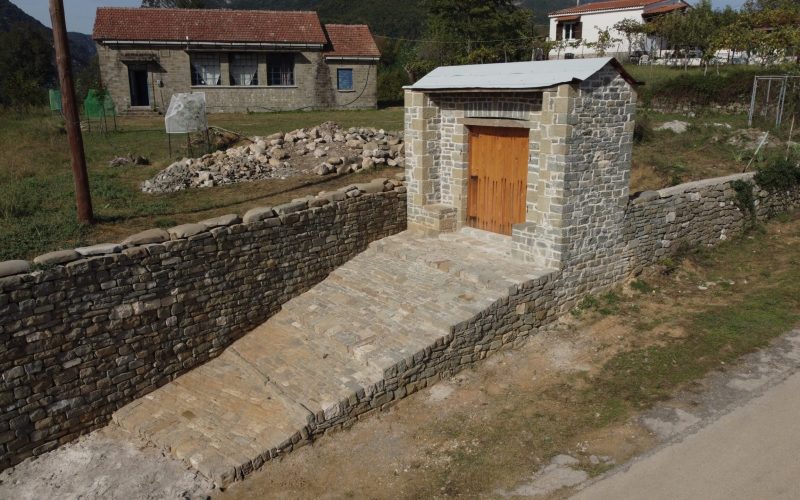
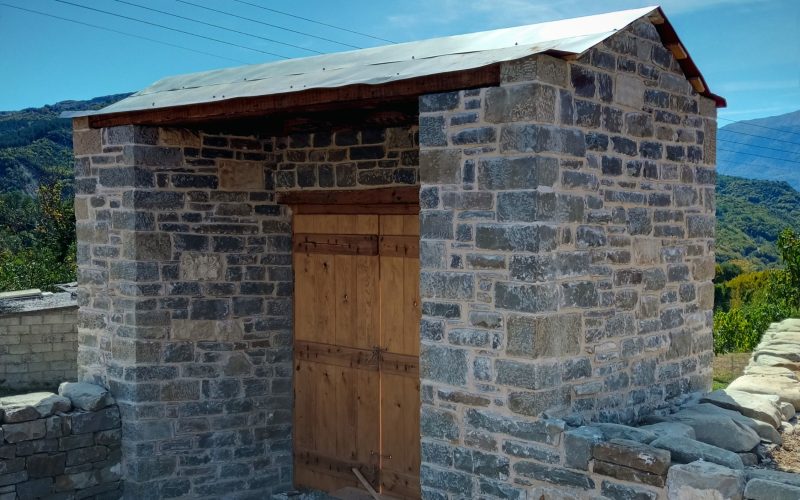
The “Summer School” was a festive workshop that summarizes and culminates the three main thematic units we have worked on in recent years at the Frasta School: stone, timber, and mortars. Through the hands-on completion of the model restoration of the building and its surrounding landscape, the event officially marks the launch and inauguration of the School of Research and Education for Traditional and Sustainable Building in Frasta, Tzoumerka, as a permanent educational structure.
The Workshop
The 3-week hands-on workshop hosted 40 participants, students and professionals across construction, architecture, engineering sciences, archaeology, cultural management, vernacular architecture, and natural building. The workshop combined theory, seminars, and practical work, lectures, community activities, and field visits, while supporting the work to complete the model restoration of the building and its surrounding area.
Stone & Dry Stone (15–19/06/2026)
As part of the ECHOES project, together with The Dry Stone Wall Association of Ireland and 4GRADA Dragodid from Croatia, we focused on:
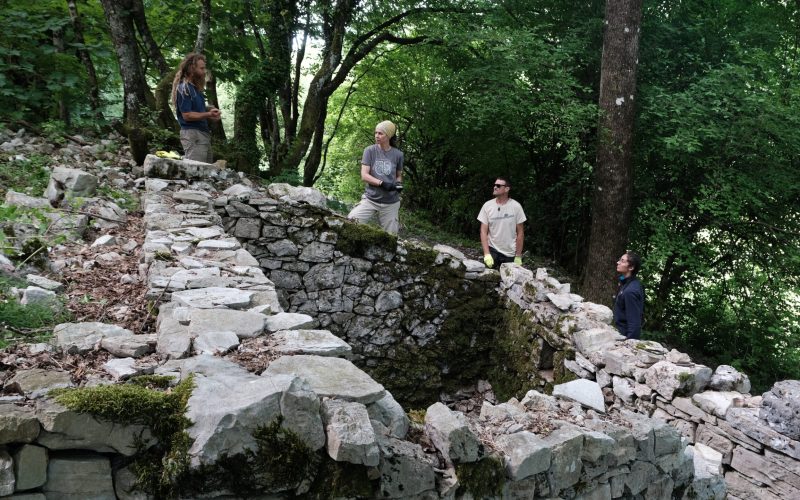
• Shaping the outdoor area with dry stone seating tiers and retaining steps at the entrance of the School, a new architectural design proposal incorporating traditional techniques.
• Restoration of dry stone retaining walls in the School’s courtyard.
Timber Structures (22–26/06/2026)
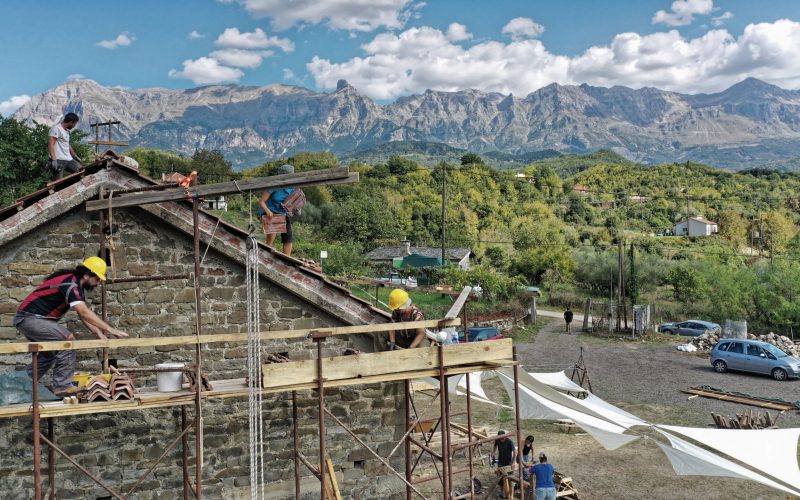
Under the guidance of Kostas Margaritis and Ismini Tsoumpari, carpentry work was carried out:
• Construction of 2 internal wooden staircases and flooring for the lofts.
• Creation of a decorative wooden balustrade.
• Application of traditional joints and cutting/assembly techniques using hand tools.
• Repair work on the wooden cabinets and their protection with natural shellac varnish.
Renders & Lime Washes (29/06–03/07/2026)
Designed by Claire Oiry (Spiti – Spitaki), Myrto Papathanasiou, and the Boulouki team, the final surfaces of the building were completed:
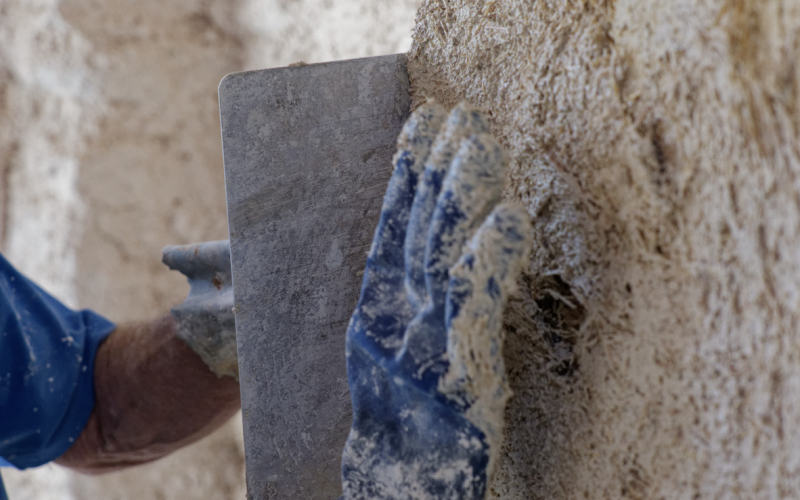
• Joint pointing with air lime mortars.
• Final clay-lime renders using marble dust and local aggregates.
• Smoothed finishes using natural Indigo pigment.
• Lime washes with organic additives, plant-based, and mineral pigments.
Methodology, Fieldwork & Community Engagement
The workshop was guided by local craftspeople, international experts from Ireland and Croatia, and the Boulouki team. Three of the instructors and craftswomen of the Summer School were previously trained in the School’s workshops and returned to take on a new role.
During the Summer School, our team carried out three exploration walks and two major hikes around the Frasta School across Plaka Kalderimi, Monopati tis Vidras, Keramidario lime kiln site, and the Arachthos river / Monastery of Moukousti area to study local geology, dry-stone walling, agroforestry, and rural infrastructure. The goal was to introduce participants to the practices and methodologies our team applies in field research, to exchange knowledge and share our long experience in the region with the local community, as well as to preserve and re-appropriate these routes.
Throughout the workshop, the program included open activities for the community. Open lectures every Monday, Thursday, and Friday evenings, Saturday collective walks & kafeneio gatherings in Frasta; and scheduled open visits to the construction site.
The Summer School was organized by Boulouki with co-organisers the Municipality of K. Tzoumerka, the Municipality of V. Tzoumerka, the Technical Chamber of Greece (TEE) of Epirus, and the Regional Union of Municipalities of Epirus. The project was supported by the Kokkalis Foundation, the Sahinis Family, the Technical Chamber of Greece, and AIGEAS AMKE. Oikos Dalkafouki supports the former apprentices and participants, who teach at the workshop as craftswomen – instructors. Under the auspices and the financial support of the Ministry of Culture.
The first week of the workshop was held in the framework of the ECHOES, Enhancing Cultural Heritage Skills Across Europe project, led by partners from Croatia (DRAGODID), Greece (Boulouki), and Ireland (Dry Stone Wall Association of Ireland – DSWAI), and was dedicated to the preservation, advancement, and promotion of European cultural diversity and heritage. The project is co-funded by the European Union, Creative Europe Program, action “European Cooperation Projects”.